Planning Blade Inspection Robot Deployment and Recovery as One Activity
Internal blade inspection robots move inspection evidence closer to the structure, but they also introduce a new planning question: what happens if the robot cannot simply drive back out? WindInspectTech's guide to blade inspection robot deployment and recovery planning gives a clear answer. Plan deployment and recovery as one controlled activity, and approve recovery before the robot enters the blade rather than improvising it after a fault.
The guide is written for asset owners and qualified inspection teams. It is a planning framework, not an operating procedure, isolation method or rescue plan, and execution belongs to competent personnel working under the site's approved system of work and the applicable OEM procedures. This article follows its structure.
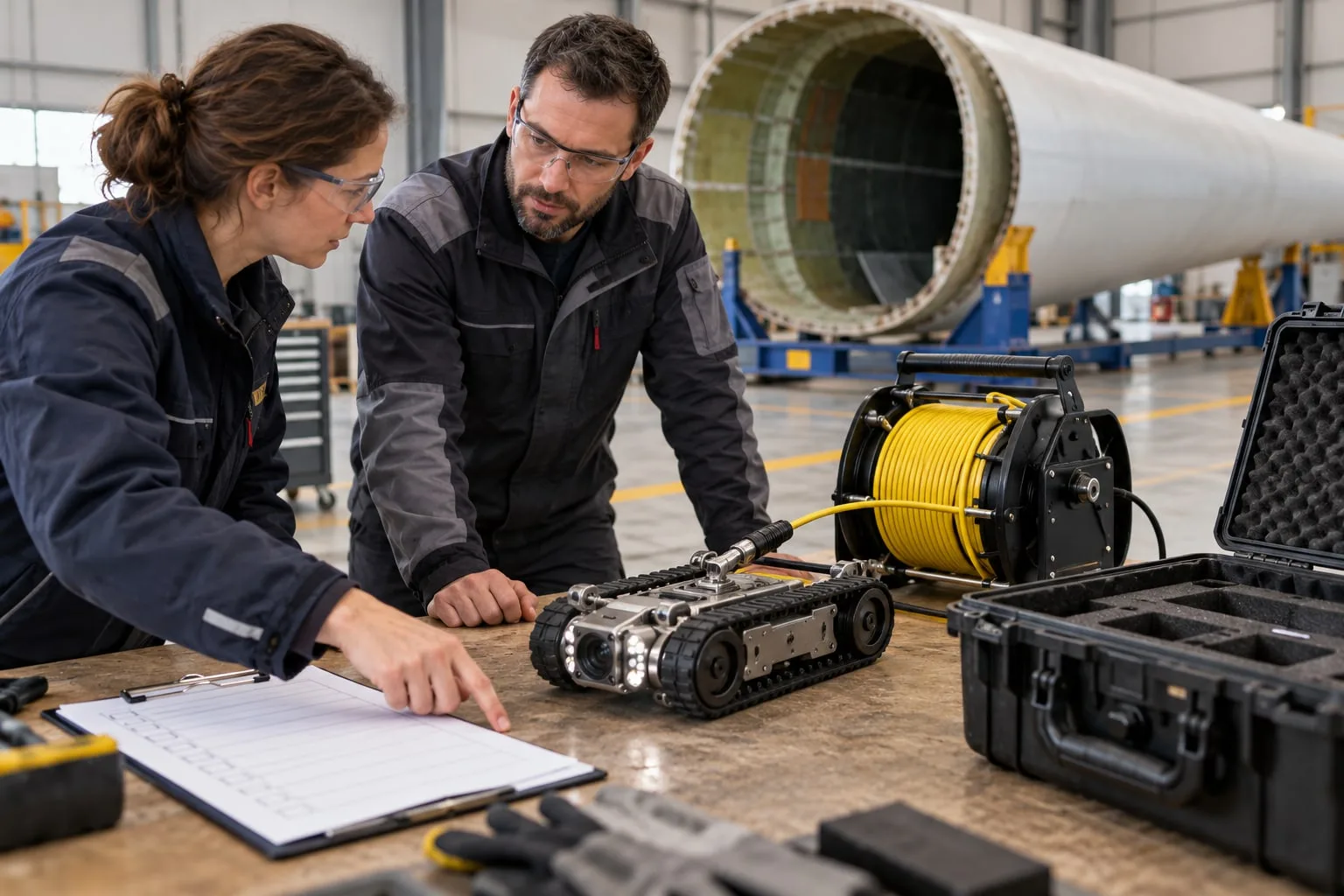
Illustration of an internal blade inspection robot being prepared for deployment at a turbine blade root. Image: windinspecttech.com.
Write a bounded mission brief
Give the mission a clear beginning and end. Identify the turbine, blade, cavity, inspection objective and planned reporting output, and record which areas are included and which need separate approval or another method.
Define completion in observable terms: the agreed images and location references have been captured, incomplete areas have been recorded, the equipment has been accounted for and the work package has reached its authorised closeout point. Keep the inspection target separate from the commercial schedule, because a planned outage window cannot show that a cavity is traversable. Access assumptions should be resolved first using the internal blade inspection robot access checklist.
Build an approval and responsibility matrix
A plan should name roles, not just list equipment. The guide's template assigns each decision an accountable role and the evidence needed before release:
- Inspection scope: asset owner or appointed engineer; defined zones, evidence requirement and exclusions
- Equipment suitability: robot supplier and qualified inspection lead; configuration review and current instructions
- Turbine access and isolation: authorised site or OEM personnel; approved site-specific work controls
- Deployment readiness: appointed work supervisor; completed checks and closed hold points
- Stop and escalation decisions: named operational authority; agreed triggers and communication route
- Equipment recovery: qualified recovery lead; approved normal and contingency arrangements
- Return to service: site-authorised release authority; required closeout and equipment reconciliation
The template does not allocate legal duties or replace the operator's own arrangements. The guide draws on UK HSE maintenance and confined-space guidance as Great Britain references.
Review the route and supporting equipment
Confirm handling arrangements, available space, cavity access and the interfaces the selected system needs. Ask the supplier for the configuration's documented power, communications and cable-management requirements. Do not assume a cable is approved as a retrieval device. The WIT-BR60 product page describes negative-pressure adhesion, illuminated camera views and location-linked reporting; it is product context, not a site procedure.
Set a realistic schedule boundary
Split the estimate into access preparation, turbine preparation, equipment setup, inspection, planned recovery, data checks and closeout, and identify dependencies between teams. The WIT-BR60's published timed value of 70 m in 60 minutes or less concerns one cavity, a 70 m internal area within a 95 m blade, with the documented setup and an unobstructed path. It is not a site-visit duration and should be kept separate from the outage estimate and from the coverage statement discussed in the guide to internal blade coverage limits.
Wind turbine rotor and blades used as the WindInspectTech site header image. Image: windinspecttech.com.
Agree stop conditions before deployment
For each foreseeable condition, settle in advance who decides:
- An unexpected obstruction or geometry: who reviews the changed route or scope?
- Loss of control, communications or monitoring: which approved contingency applies?
- Images failing agreed quality: who decides whether to repeat capture?
- Changing site or environmental conditions: who reassesses the work authorisation?
- An uncertain return route: who controls recovery escalation?
- A reduced work window: what scope can be deferred without ambiguous reporting?
A short briefing record confirms that people understand these boundaries. Schedule pressure must not change an approved limit. If the available window shrinks, it is better to defer a clearly defined zone and report it as not inspected than to shorten checks or stretch a stop condition to finish the planned route.
Separate equipment recovery from human rescue
Normal retrieval, equipment-fault contingencies and emergencies involving people are different categories with different specialists. A stranded robot does not authorise anyone to enter the blade or improvise a pulling arrangement. The guide deliberately gives no retrieval mechanics or rescue techniques.
Close out equipment and evidence together
The handover checklist covers reconciling equipment against the mobilisation inventory, recording recovery status and abnormal events, distinguishing completed from incomplete zones, retaining original captures and location references, separating observations from reviewed classifications, assigning outstanding questions and completing return-to-service approvals. The resulting record should meet the expectations in what a blade inspection report should include. Mission outlines can be sent for review to sales@windinspecttech.com or via the contact page.
FAQ
When should the recovery plan be approved?
Before deployment, with its applicability checked against the actual configuration and route.
Can the advertised run time set the outage duration?
No. The total programme also includes preparation, access, recovery and closeout. The 70 m in 60 minutes value is a conditioned one-cavity scenario.
Is a robot's tether a retrieval device?
Not by assumption. Ask the supplier for documented cable-management and recovery arrangements for the configuration.
Does this guide provide rescue procedures?
No. It is a planning framework; rescue and isolation belong to authorised site personnel under applicable regulations.
Contact WindInspectTech: email sales@windinspecttech.com · windinspecttech.com